User Profile
How Profile Building Works: Step-by-Step
The AI Agent's recommendations are only as good as the profile data it receives. Here's how OROKAI builds a comprehensive user profile while keeping it simple:
Profile building journey (5-10 minutes)
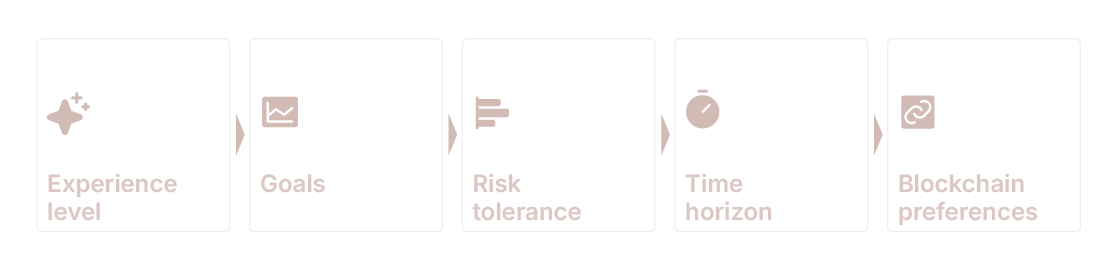
STEP 1: Experience level
How familiar are you with decentralized finance (DeFi)?
DeFi refers to on-chain financial applications.
I’m not familiar with DeFi yet
I understand the basics and have tried it
I’m comfortable using DeFi protocols
STEP 2: Goals
What is your primary objective?
Tell us what you want to achieve with DeFi investments.
Capital preservation
Passive income
Capital growth
Diversification
Exploration & learning
STEP 3: Risk tolerance
What's your risk tolerance?
Help us understand how much risk you are comfortable with.
Conservative
Balanced
Opportunistic
STEP 4: Time horizon
For how long do you plan to keep funds active?
This helps us align protocol visibility and time-related constraints.
Short-term (< 3 months)
Medium-term (3-12 months)
Long-term (1+ years)
STEP 5: Blockchain preferences
Which blockchain environments do you prefer?
Select your preferred ecosystem.
The main network (Ethereum (L1))
Lower-fee networks (Ethereum L2s (Polygon, Base))
Other blockchains (Alternative ecosystems (BNB Chain, Solana, Cosmos))
OROKAI adapts its suggestions based on user-provided interaction context, including:
• User responses during onboarding
• Current assets visible in the user’s wallet
• Open allocations
When onboarding is skipped, the system applies a predefined default profile.
Profile Mechanics
Privacy
OROKAI does not collect or store personally identifiable user data. Each user is assigned a system-generated identifier, which is used solely to associate interaction responses and system outputs.
Onboarding responses are linked to this identifier and processed to assign the user to one or more predefined content context groups. These groups represent generalized behavioral and preference categories rather than individual user profiles.
Profile data is used exclusively for personalization of informational outputs and does not authorize the Agent to execute transactions or take actions on behalf of the user. All processing is performed in accordance with the applicable Privacy Policy.
Context Grouping Logic
User inputs collected during onboarding are evaluated by the backend using a deterministic classification algorithm. Based on the selected responses, the system assigns the identifier to relevant content context groups.
These groups are used to:
• Scope informational notifications
• Filter protocol and network visibility
• Adjust the relevance of surfaced data
The Agent generates messages at the group level, not the individual level. The backend then distributes these messages to identifiers associated with the corresponding groups.
No persistent behavioral tracking or individual profiling is performed beyond group assignment.
Module Output
The Profile Card (derived from group-level context), displaying:
• Goals
• Risk level category
• Preferred chains
• Operational constraints
The Profile Card represents a contextual summary, not a user account or identity.
The profile serves purely as input for recommendations – the Agent never acts autonomously, and all transactions require explicit user signature.